Build-a-Bear Program at Marcus Public Library
By Elaine Rassel
At last the Build-a-Bear Program found a time when the weather was suitable! This program, sponsored by Friends of the Library, had been planned earlier in the year but many snowy winter days caused it to be canceled.
Marjo Daum asked the kids if they had ever seen a real bear. Yes, some of them had seen bears at a zoo. She reminded them to “not feed the bears”. (When going through state parks, bears are always seen walking around. Because of the many people seen, the bears are not afraid and will come up to a car looking for food as some people have fed them before. Bears are not friendly if they don’t get the food they are expecting. So, it is not a good idea to even try and feed them. Keep the car windows up and leave the bears alone.)
Marjo spoke on the 8 species of bears in the world. She had pictures of them and gave some information on each of them. (I only wish each picture she held up could have been printed so you could see the beauty of each.)
- North American Bear is seen from northern Florida to Alaska. It eats berries, roots, salmon, deer, insects, and some times dead animals. They weigh less then 1 pound at birth, 20-30 pounds at 3 months, and keep growing for 8 years and can weigh over 600 pounds. They hibernate from Nov.-Mar. when they live off the fat they have stored. Baby bears live with their mother for 3 years. Their lifespan can be 20 years.
- The Brown Bear is found in Alaska, western Canada, and parts of Washington, Montana, and Wyoming. They eat fleshy roots, berries, grasses, fish, squirrels, moose, elk, and dead animals—also cattle and sheep. They have very long front claws used for digging and have a bump of muscle on their shoulders. They usually have twin baby bears and take care of them for 2 years. Adult bears can weigh 700 pounds. They hibernate for 7 months. They can live for 30 years. The can run up to 35 mph. They use sound, movement, and smells to communicate. They growl, moan, or grunt. They are fierce fighters. They rub their bodies on trees to scratch and let other bears know they are there.
- Polar Bears live on sea ice of the Arctic Ocean. They eat seals, birds, eggs, vegetation, and dead animals. They are the largest bears in the world and weigh up to 1760 pounds and can reach over 10 feet tall when standing. The use their front paws to paddle and hold their hind legs flat like a rudder. They can gallop as fast as a horse. Polar bear skin is black and hair is clear that looks white when seen. They have 2 layers of fur to keep warm when sleeping on snow and ice. They have 3 eyelids, 42 razor sharp teeth, a blue tongue, and 4 inches of fat to keep warm. They can have 1-4 cub babies that stay with their mother for 2 years.. The can live for 20-30 years.
- The Asiatic Black Bear lives in eastern Asia mostly in forested hills and mountains. They eat small mammals, birds, fish, grasses, fruits, berries, seeds, insects, honey, and nuts. Two cubs stay with their mother for 3-4 years. Adult bears can weigh 220-440 pounds and live as long as 25 years in the wild. They have a glossy black coat with whitish mark shaped like a crescent moon on its chest and has long and course shoulder hair. In northern climates they hibernate but not in southern climates.
- The Andean Bear is only found in Andes Mountains in South America. They eat mostly plants, rodents, and insects. They have up to 4 cubs at a time and stay with their mother for 1 year. Adult bears can weigh 220-386 pounds and can live for about 20 years in the wild. They have rings of white or light fur around their eyes with the rest of fur being black. Their front legs are longer than the back legs. Cubs can ride on mother’s back or she can carry cubs by clutching it to her chest with one front paw as she runs on 3 legs or walks on her hind legs.
- Panda Bears are found in 6 mountain ranges in western China. They eat bamboo and because it is nutritionally poor, they have to eat over 44 pounds a day. Cubs are born 1/900th the size of its mother and are hairless, pink, and blind. Adult bears can weigh over 250 pounds. They have an extra digest on their hands so they can tear the bamboo. Their gut is covered with a thick layer of mucus to protect against sprinters. They do not hibernate but move to lower elevations to stay warm and go to higher elevations in summer to get cool.
- Sloth Bears are found in Sri Lanka, India, Bhutan, Nepal and Bangladesh. They eat ants, termites, fruits and seeds. The are noisy eaters—can hear them eat a long ways away when sucking up termites.
They weigh 300 pounds. They are stocky with long, shaggy, black hair with a white “U or V” shape on their chest. They have large lips, long tongue, pale muzzle, and well developed hook-like claws that let them climb trees and dig for termites. They don’t have front teeth (adaptation for sucking termites that allows them to suck like a vacuum). They are mostly seen at dawn, dusk, and in darkness of night. Their biggest enemy is the tiger. They do not hibernate. They carry their cubs on their back for the first 7 to 9 months. Adult bears live less than 20 years in the wild. - The Sun Bear lives in southeast Asia. They eat insects, termites, small birds, rodents, lizards, berries, roots, and fruits. They are the smallest species of bears. They weigh around 148 pounds. They have a 9 inch tongue that enables them to get honey from nests. They have short black water repellent fur with yellow crescent on their chest. They have strong paws with naked soles and long sickle shaped claws. They have the largest canine teeth of all bears for use of weapons and tearing at trees to get insects. Cubs are born in trees or dens, usually only one cub. They are born blind and helpless and stay with their mother for 2 years. Adult bears can live 15 to 30 years.
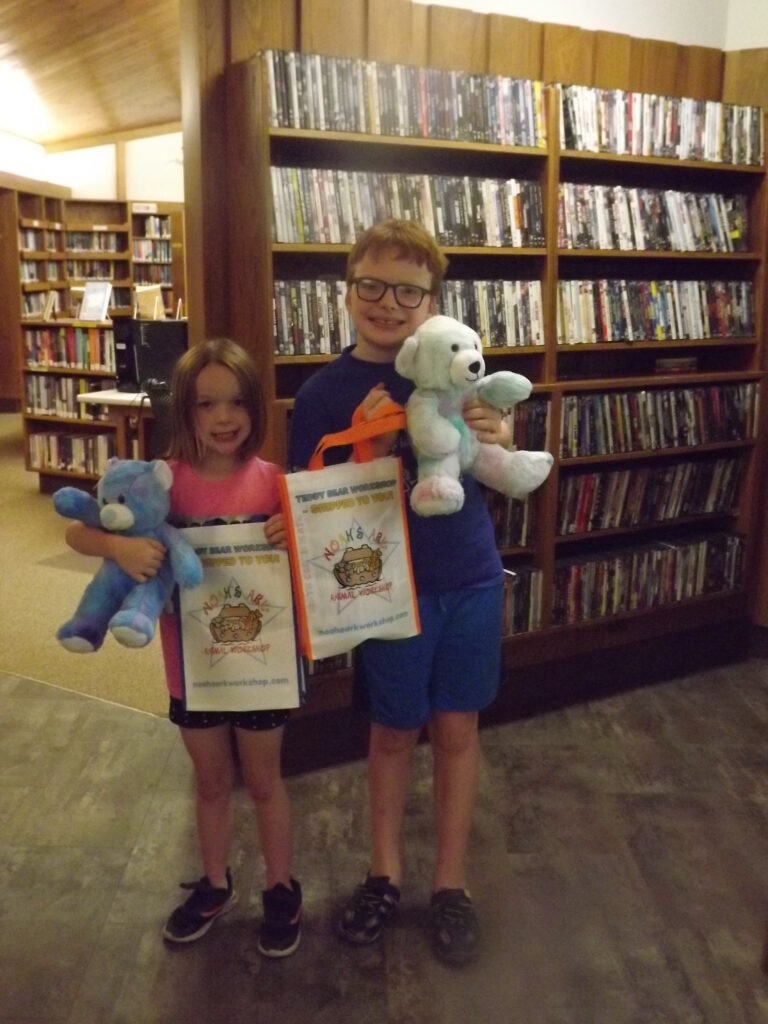
There were 31 kids there to get a bear to stuff. 3 kids were not present that had signed up. There were approximately 15 adults present for this interesting program. Each kid drew out a color of bear to stuff. There were 8 different colored bears to choose from. (Bears were: Sugar Plum Teddy, Icee Polar Bear, Chocolate Kisses Teddy, Ocean Blue Teddy, Carmel Bear, Candy Corn Teddy, Pebbles Teddy, and Stone Black Bear.)
If there was more than one in a family that drew the same color then they could redraw. They were given a package of white stuffing to stuff their chosen bear with. They also put a star inside the bear and then zipped the bear shut. They got to name their bear and Dallas wrote it in the certificate that they also got. They were given a bag to put the bear and certificate in.
The kids were given a cookie to eat before they left with their bear.
Helping with this interesting program were Dallas Carey, Marjo Daum, Darcy Dreckman, and Linda Klingbeil.