Elephants Come to Marcus Public Library
Last week the Library had the Blank Park Zoo from Des Moines come with two animals that are only seen at presentations and never seen at the zoo—a gecko and a Tenrec. The gecko was different that it was “spotted” and is classified as a lizard. It has been known to shelter under loose bark of trees or in crevices in rocky habitats when seeking arid and semi-arid areas with sparse vegetation and clay or sandy soils are needed to live. They avoid areas where the primary substrate is sand. The spots are useful as camouflage when being hunted by their enemies. They can be pets but the price is very costly! (There was an article on the gecko that didn’t get printed last week.)
The Tenrec can be also known as a “hedge hog”. While Tenrecs can climb, hedge hogs cannot. Their lifespan is 8 to 10 years.
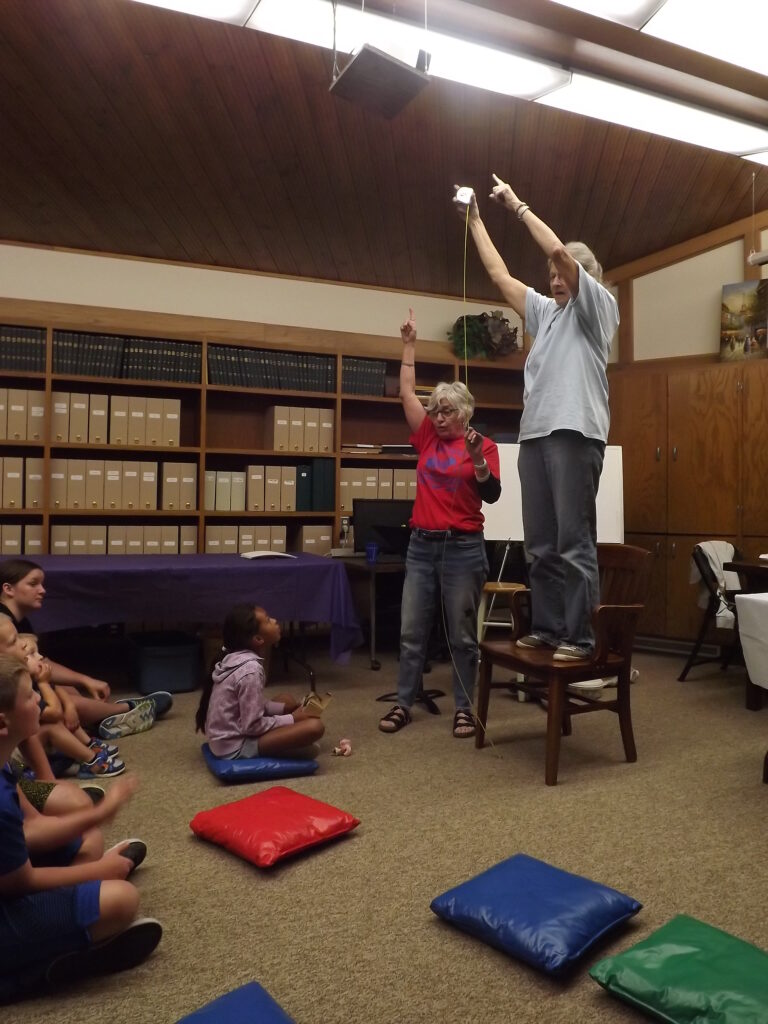
While these animal visitors were small in size, the latest animal to come to the Library is just the opposite—the largest existing land animal known as the “elephant”. Anna Schmadeke and Kay gave an informative presentation on elephants on Wednesday (July 19). No, they did not bring a live elephant!
Kids went on a safari looking for elephants in the Library with “flashlights”! Elephant books were hidden in the Library but they were found. After the safari was over, the audience of people of all ages were told many facts on elephants that they were probably not aware of.
Elephants are the largest existing land animal. There are three living species recognized—the African bush elephant, the African forest elephant, and the Asian elephant. African bush elephants and Asian elephants are listed as endangered and African forest elephants are critically endangered by the International Union for Conservation of Nature (IUCN). One of the biggest threats to elephant populations is the ivory trade, as the animals are poached for their ivory tusks.
Other threats to wild elephants include habitat destruction and conflicts with people. In Asia, elephants are used as working animals. Many years ago they were used in war but today they are put on display in zoos or can be found in circuses. Humans look to the elephant where they are featured in art, folklore, religion, literature, and popular culture.
Distinctive features of elephants include a trunk, tusks, large floppy ears, legs looking like pillars, and tough but sensitive skin. Of what use is the large trunk? The trunk has no bones but is able to bring food and water to the mouth and also uses it to grasp things.
Tusks come from the incisor teeth and are used as weapons as well as tools for digging or moving objects. Teeth can weigh 5-6 pounds and have 26 teeth. (Each tooth could be compared to what a brick weighs.) Ivory, coming from a tooth, will dry up and crack if not kept cool and wet. The large floppy ears flop to maintain constant body temperature and even used as a form of communication. To communicate, they greet each by tangling their trunks.
Elephants are the largest living terrestrial animal with 326-351 bones making up its skeleton. The vertebrae are connected by tight joints. Because of this, there is limited backbone flexibility. They use 10 gallon pails of water a day—some to drink and because their skin is sensitive, the rest is sprayed on the skin so it doesn’t get sunburned. They eat over 300 pounds of food a day. They only sleep 4 hours a day.
Male elephants leave their family groups when they teach puberty and may live alone or with other males but will interact with family groups when looking for a mate. Calves are the center of attention and rely on their mothers for as long as 3 years. Elephants can live up to 70 years in the wild. They can communicate by touch, sight, smell and sound; they use infrasound and seismic communication over long distances. Elephants show concern and have been known to stay by a dead elephant for two to three days.
Elephants are known for their wonderful memory. Some remember 60 commands. They can make sounds we cannot understand. There is one thing elephants are afraid of—bees! Their sensitive cannot be stung by a bee.
Elephant’s flexibility allows it to wrestle other elephants, can lift up to 770 pounds, but has the precision to crack a peanut shell without breaking the seed. It can reach items up to 23 feet high and dig for water in the mud or sand below. They can breathe in almost 30 tines faster than a human sneeze and after sucking up water, can squirt it into the mouth or over the body. While under water, it uses it’s trunk as a snorkel.
The trunk acts as a sense organ. There are whiskers that grow along the trunk and are packed at the tip. Unlike cats and rats, elephant whiskers do not move independently to sense the environment; the trunk itself must move to bring the whiskers into contact with nearby objects. Whiskers grow in rows on the ventral surface of the trunk which is thought to be essential in helping balance objects there.
Do all elephants look alike? African elephants have larger eats and concave backs, and Asian elephants have smaller ears and level backs. The African elephants have two finger-like extensions at the tip of the trunk that allow them to pluck small food, while the Asian elephant has only one and relies more in wrapping around a food item. Asian elephant trunks have better coordination.
Kids got to color a picture of an elephant, each received a bookmark, had a sticker craft, and colored a wooden elephant as well as learning more on elephants without having an elephant there!