Insects Invaded Marcus for a Short Time
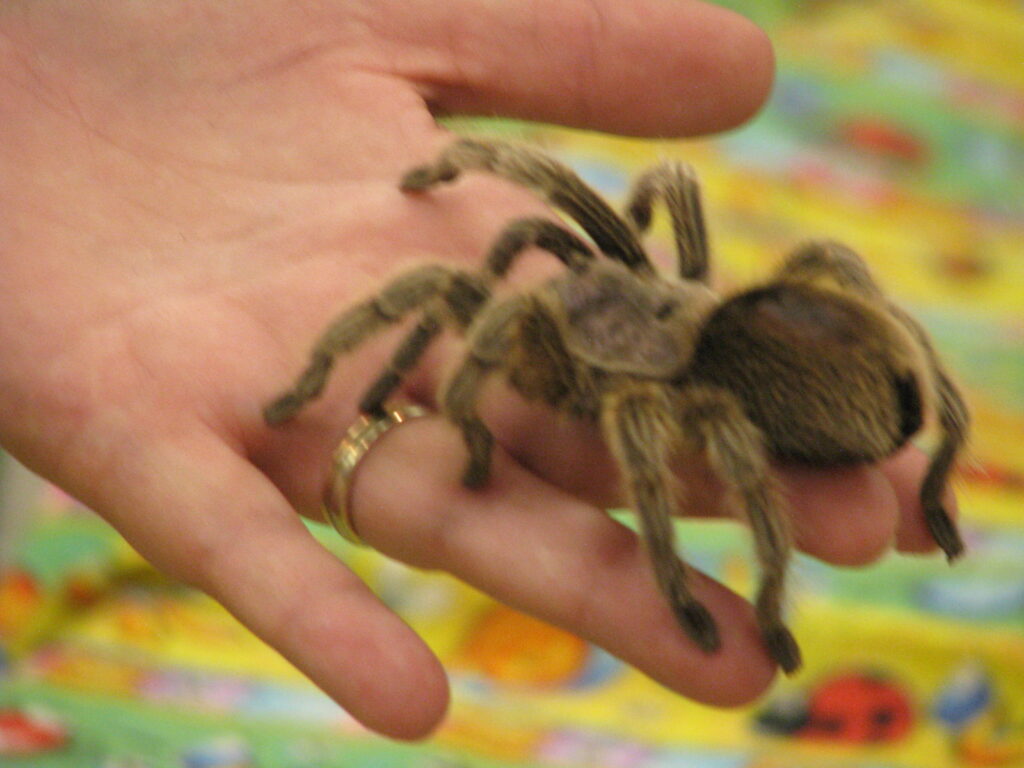
Yes, there were insects of all kinds that were in Marcus on Wednesday, June 29. No need to worry as the insects were confined to their cages and all went back to Iowa State University. The Marcus Public Library would not have the room needed to show these insects, so they were seen at the Marcus Community Center. There were many tables set up where the insects’ cages were. (I don’t know if “cage” is the right word for where they were kept, but will call them that anyway!)
There were Hercules Beetles, millipedes, Beetles, Roaches, Grasshoppers, Walkingsticks, Butterflies, Mantis, Scorpions, and Tarantulas displayed.
Grasshoppers are one of the insects we have in our area. They are sought to have been around 250 million years ago. They are typically ground-dwelling insects with powerful hind legs which allow them to escape from threats by leaping vigorously. The grasshopper hears through an organ which can be found in the first segment of the abdomen attached to the thorax while its sense of vision is in the compound eyes, the change in light intensity is perceived in the simple eyes. At high population densities, some grasshopper species can change color and behavior and form swarms. Under these circumstances, they are known as locusts. (Is this what we hear supposedly six weeks before the first frost?)
Grasshoppers have the typical insect body plan of head, thorax and abdomen. The head is held vertically at an angle to the body with the mouth at the bottom. The head bears a large pair of compound eyes which give all-round vision, three simple eyes that can detect light and dark, and a pair of thread-like antennae that are sensitive to touch and smell. The downward-directed mouthparts are modified for chewing and there are two sensory palps in front of the jaws.
The abdomen has 11 segments, the first of which is fused to the thorax and contains the typanal organ and hearing system. Segments two to eight are ring-shaped and joined by flexible membranes. Segments nine to eleven are reduced in size segment nine bears a pair of cerci and segments ten and eleven have the reproductive organs. Females are normally larger than males. Grasshoppers can make noise by rubbing a row of pegs on the hind legs against the edges of the forewings. Grasshoppers may be confused with crickets because of the sound they make—but they are not crickets.
Grasshoppers are plant-eaters, with a few species at times becoming serious pests of cereals, vegetables and pasture, especially when they warm in the millions as locusts and destroy crops over wide areas. They protect themselves from predators by camouflage; when detected, many species attempt to startle the predator with a brilliantly-colored wing-flash while jumping and launching themselves into the air, usually flying at a short distance.
A Hercules Beetle was displayed. It is known for its tremendous strength and is named after Hercules, a hero of classical mythology who is famed for his great strength. It is native to the rainforests of Central America and South America. It is the longest extant species of beetle in the world, and is also one of the largest flying insects in the world.
Adult body sizes (not including the thoracic horn) can be 2 to 3.3 inches in length and 1.1 and 1.7 in with. Male Hercules beetles may reach up to 7 inches in length including the horn. Its jaws and/or horns are included in the measurement. The size of the horn is naturally variable, more so than any variation of the size of leg, wings, or overall body size in the species.
The larvae of the Hercules beetle feed on rotting wood; they reside in same during their two-year developmental stage. The adult Hercules beetle feeds on fresh and rotting fruit. They have been observed feeding on peaches, pears, apples and grapes in captivity.
Within their native rain forest habitats, the adult beetles, which are nocturnal, forage for fruit at night and hide or burrow within the leaf litter during the day. The adult are capable of creating a “huffing” sound that serves as a warning to predators. The Hercules beetle is able to carry up to 850 times its body mass. Hercules beetles do not affect human activities, either as an agricultural pest or disease vector.
Lets move on to a cage with a scorpion. There was a person that held a scorpion. Scorpions have eight legs and are easily recognized by a pair of grasping pincers and a narrow, segmented tail, often carried in a characteristic forward curve over the back and always ending with a stinger.
History of the scorpion goes back 435 million years. They mainly live in deserts but have adapted for a wide range of environmental conditions and can be found on all continents except Antarctica. There are over 2,500 described species, with 22 extant (living) families recognized to date.
Scorpions primarily prey on insects and other invertebrates, but some species hunt vertebrates. They use their pincers to restrain and kill prey, or to prevent their own predation. The venomous sting is used for offense and defense. All known species give live birth and the female cares for the young as their exoskeletons harden, transporting them on her back. The exoskeleton contains fluorescent chemicals and glows under ultraviolet light.
The vast majority of species do not seriously threaten humans, and healthy adults usually do not need medical treatment after a sting. About 25 species (fewer than 1%) have venom capable of killing a human, which happens frequently in parts of the world where medial treatment is unlikely.
Scorpions appear in art, folklore, mythology, and commercial brands. Scorpion motifs are woven into kilim carpets for protection from their sting. Scorpius is the name of a constellation.
Moving on down the line of cage, we find a Tarantula. They comprise a group of large and often hairy spiders. There have been 1,010 species identified. Some of the more common species have become popular in the exotic pet trade. Many New World species kept as pets have found the hairs of the Tarantula can cause irritation to the skin and in extreme cases, cause damage to the eyes.
The Tarantula is an invertebrate that relies on an exoskeleton for muscular support. A Tarantula’s body comprises two main parts. The two parts are connected by a waist-like connecting piece. Tarantula sizes can range from as small as the size of a BB pellet to as large as a dinner plate when the legs are fully extended. Depending on the species, the body length of Tarantulas rang from about 2 to 4 _ inches with a leg span of 3 to 12 inches. Leg span is determined by measuring from the tip of the back leg to the tip of the front leg on the opposite side. Some of the largest Tarantulas may weigh over 3 oz. With a goliath birdeater species fro Venezuela and Brazil weighing 6 oz with a leg span of up to 12 inches.
Most species of North American tarantulas are brown in color. There have been cobalt blue or black with white stripes. Their natural habitats include savanna, grassland such as in the pampas, rainforest, desert, scrubland, mountains, and cloud forest. They are burrowers that live in the ground. Tarantulas are becoming popular as pets and some species are readily available in captivity.
Some Tarantulas hunt prey primarily in trees while others hunt on or near the ground. All tarantulas produce silk. Terrestrial species line their burrows with silk to stabilize the burrow wall and facilitate climbing up and down. They mainly eat large insects such as centipedes, millipedes and other spiders, using ambush as their primary method of prey capture. Armed with their massive, powerful chelicerae tipped with long fangs, Tarantulas are well-adapted to killing other large arthropods. The biggest Tarantulas sometimes kill and eat small vertebrates such as lizards, mice, bats, birds, and small snakes.
Humans consume Tarantulas for food in their native ranges. They are considered a delicacy in certain cultures in Venezuela and Cambodia. They can be roasted over an open fire to remove the bristles and then eaten. Tarantulas have bristles to defend themselves. Besides the normal bristles covering the body, some have a dense covering of irritating bristles (or hairs) that are used in protection against enemies.
Like other spiders, Tarantulas have to shed their exoskeleton periodically as they grow, a process called molting. A young Tarantula may do this several times a year as part of a maturing process, while full-grown specimens only molt once a year or less, or sooner, to replace lost limbs or lost hairs. Molting is imminent when the exoskeleton takes on a darker shade. The Tarantula stops feeding during this time.
This very informative presentation of insects was from the Iowa State University where the Department of Entomology has an insect collection of over200 arthropods—the largest in America.
On Saturday, August 27, 2022 at 9 a. m., there will be an EGSO event located at ATRB 2213 Pammel Dr. for an Insect Day.
Insect day is an opportunity for individuals in the Ames and surrounding communities to learn from Iowa State graduate students! This event will begin with short informational sections on the insects we encounter in our daily lives followed by an insect collection event. All ages and skill levels are welcome! Each participant will receive an informational packet, an insect pinning kit and lunch! All participants under the age of 18 must be accompanied by adult. Cost of admission along with pinning supplies is $20, for anyone who wishes to observe (no supplies) the cost is $5.
I want to give credit for this interesting program information to Steve S. and thank him for attending it when I was gone.