Ships and Planes at Pearl Harbor
were not Prepared on December 7, 1941
By Elaine Rassel
Should we put the past in the past and not want to recall an event that changed the lives of many people?
World War I was supposed to have been the end of all wars. But this was not to be. It was December 7 that the Japanese bombed the United States naval base at Pearl Harbor. This 7:30 a.m. surprise bombing on our ships brought the United States into World War II.
That Sunday morning, the sailors on the ships were busy doing their daily duties when the Japanese struck. A sailor on the “Oklahoma” remembered his ship as being “never less on the alert” than that fateful morning of December 7. The ship was due for an inspection and was as tidy as it was unready for action. Their anti-aircraft guns had no firing pins and the ammo ready boxes had no ammunition in them. This was so the guns and ready boxes would be clean for inspection.
Crews on ships in Pearl Harbor heard bells and alarms that seemed reminders to go to church. Ignoring all signals, many dozed in their bunks. A torpedo took out the Oklahoma’s electricity a real message and three more laid open the ship’s port side. The boat-swain heard the order on the ship’s public address system. “Man your battle stations!” He found the anti-aircraft ammunition storage boxes locked, as were the fire and rescue chests. He went for a hammer and chisel as the Oklahoma began to list so heavily to port that he had to walk uphill. Sliding into the oily water, he floundered about until he located lines from the nearby “Maryland” and was pulled up to the deck.
While the musicians on the “Nevada” finished morning colors and packed away their instruments before going to gun stations, seamen on other ships smashed magazine locks to get at ammunition. The destroyer “Blue” and the repair ship “Vestal” were firing vigorously by 8:05 just as the Vestal was taking two bomb hits. The “California” absorbed its first torpedo at 8:05, and more followed. Also scheduled for inspection on Monday, the battle ship had been made ready early to keep Sunday free. Covers had been removed from six of the manholes opening into her double bottom, and a dozen more loosened. Water surged through them.
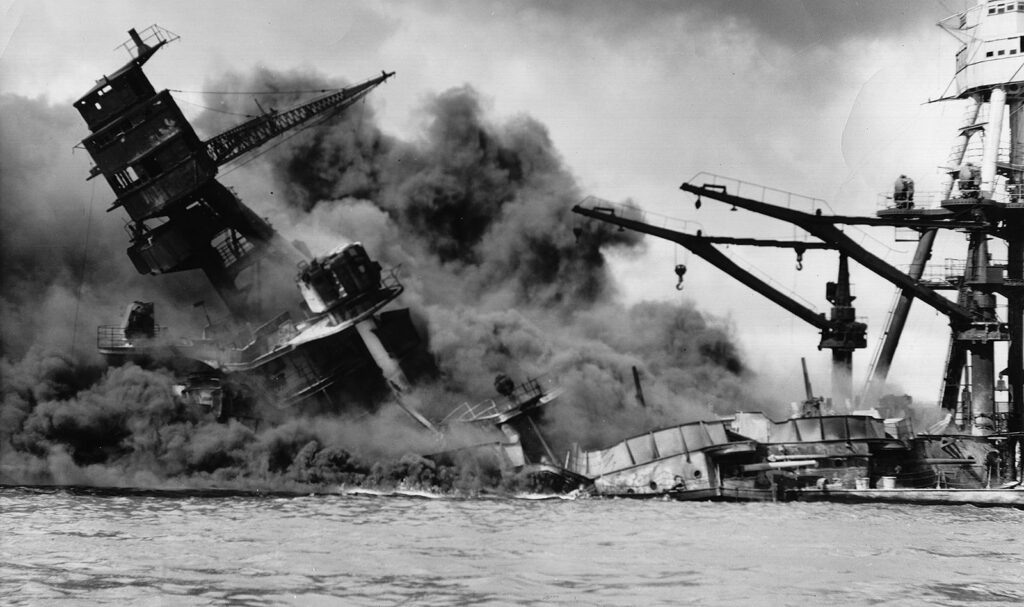
In a searing flash at 8:08, Fuchida saw from his plane, an armor-piercing bomb detonated in the forward magazine of the Arizona. The ship crumpled and sank with a thousand men trapped below. Debris from the Arizona engulfed the Vestal chunks of the ship and its equipment and even “legs, arms, and heads of men all sorts of bodies.
Flooded by torpedo hits, the listing Nevada tried to get up steam and move away from the burning oil pouring out of the Arizona. Realizing it, Japanese pilots saw a chance to block the channel with the hulk of the Nevada. They went after the crippled ship again.
In the plotting room of the Nevada, a call was received to send half the men topside to man the 5-inch AA guns. Five decks below the main deck, they were already below the surface of the water outside the ship. No one was safe above, where crewmen had already been hit with machine gun fire from low flying aircraft and killed, but the big gun directed from below was useless against aircraft. The ones going topside thought they were going to their deaths and the ones who were staying below thought they might get trapped down there. A telephone message said the nearby Oklahoma had turned bottom-up.
With fires forward still out of control, the beached Nevada’s stern began to swing out toward the Pearl Harbor channel. Harbor tugs came alongside and began pushing the stern toward the beach. The ship broke loose, drifting toward the western side of the channel. Then its undamaged engines began turning over at two-thirds reverse speed, and by 10:45, the Nevada was regrounded on the western side, listing to starboard. Five more hours would be needed before the fires were sufficiently out that work would begin to remove the dead.
Burning slowly_as it does under atmosphere pressures and temperatures_fuel oil from ruptured tanks enveloped the broken hulk of the Arizona. When the senior surviving officer aboard the Arizona abandoned ship with the rest of his men at 10:02, there were few able to leave with him. Only 39 aboard the Arizona survived; 1,102 bodies remained below. A motor launch from the overwhelmed Solace took the wounded.
The luckiest of the crew of the Solace about 250 were already ashore on weekend liberty, granted only to officers and top two grades of enlisted men, first class petty officers and chief petty officers. For the rest of the seamen, there had been little reason to weekend ashore anyway; the bars and brothels were too expensive for men who were paid $30 a month. At the West Virginia, the launch picked up more oil-soaked men from the water, then off-loaded the unwounded at the submarine dock.
The aforementioned were about ships struck but there were airplanes that were shot down as well. The Flying Fortresses scattered across Oahu. Lieutenant Bostrom gave up on Hickam Field when ships in Pearl Harbor began firing at him. He found a cloud, then tried Hickam Field. This time zeros pounced on him, disabling two of his engines, and he bumped down on the Kahuku Golf course. Evading friendly fire, other fortresses sneaked into Hickam. Landon radioed the tower to say that he had enough fuel for Hilo, on the big island of Hawaii, but was also talked down into chaotic and burning Hickam Field.
As he banked to land, Captain Blake in the tower warned, “You have three Japs on your tail and the anti-aircraft fire is erratic!” Landon did get in and touching down at Hickam Field, Lieutenant Bergdoll thought he was in the most realistic drill he had ever experienced, until he saw the debris of a B-24, the newest bomber in the Air corps arsenal and the only one in Hawaii_burning beside the runway. It was no smoke-pot exercise.
The bullet-riddled B-17, with three of the crew wounded, limped toward Bellows Field with enemy planes on his tail. A few miles further were the thousand-foot Koolau Cliffs overlooking the sea_and the pilot running out of gas. Crash-landing, downward, on the too-short runway, he skidded into the grass. The B-17 affair had taken all of ten minutes. By 8:20 a.m., all were down. Of the twelve that had flown the route, four were wrecked.
An UP bulletin from Honolulu reported, “A group of four-motored bombers bearing the rising sun insignia of the Japanese Air Force was met by a terrific barrage of anti-aircraft fire,” and another two hours later observed that the Japanese raiders had included “four-motored Flying fortresses.” No such planes could have lifted off from carriers, and in any case, the Japanese had no such bombers. But the cost in MISIDENTIFICATION of American plane over Oahu would bring with it a lesson. No more would the American star insignia on aircraft include a RED Disk. Panic and poor training may have been more responsible than a misread meatball, but the RED CIRCLE would DISAPPEAR from American planes.
Major General Martin heard noises. Looking out, he saw red balls on aircraft wings, fixed landing gear, and pillars of smoke from the Harbor and from Hickam field. Despite his being Air Corps chief in Hawaii, no one had yet informed him of what was happening. He called to Wheeler field and demanded, “Get your pursuit ships in the air just as fast as you can!” Davidson, in control at Wheeler Field, explained his unit was under attack and that they were “struggling” to get some planes in the air. Because the war warning had been downgraded in Hawaii into a sabotage alert, most of his aircraft, including 75 newly delivered P-40’s, some of them already gutter and burning, couldn’t fly. Not only were they parked in a clot: they were empty of fuel and ammunition.
Survivors of the ships and planes, clearly state that Pearl Harbor was NOT prepared on the morning of December 7, 1941. Because of this, the United States was brought into World War II.