Animal Tail Tales
By Elaine Rassel
That’s a catchy title, isn’t it? Want to learn more about it? Join Laura Jones as she tells about “tails” of animals! She was the Library speaker on Wednesday.
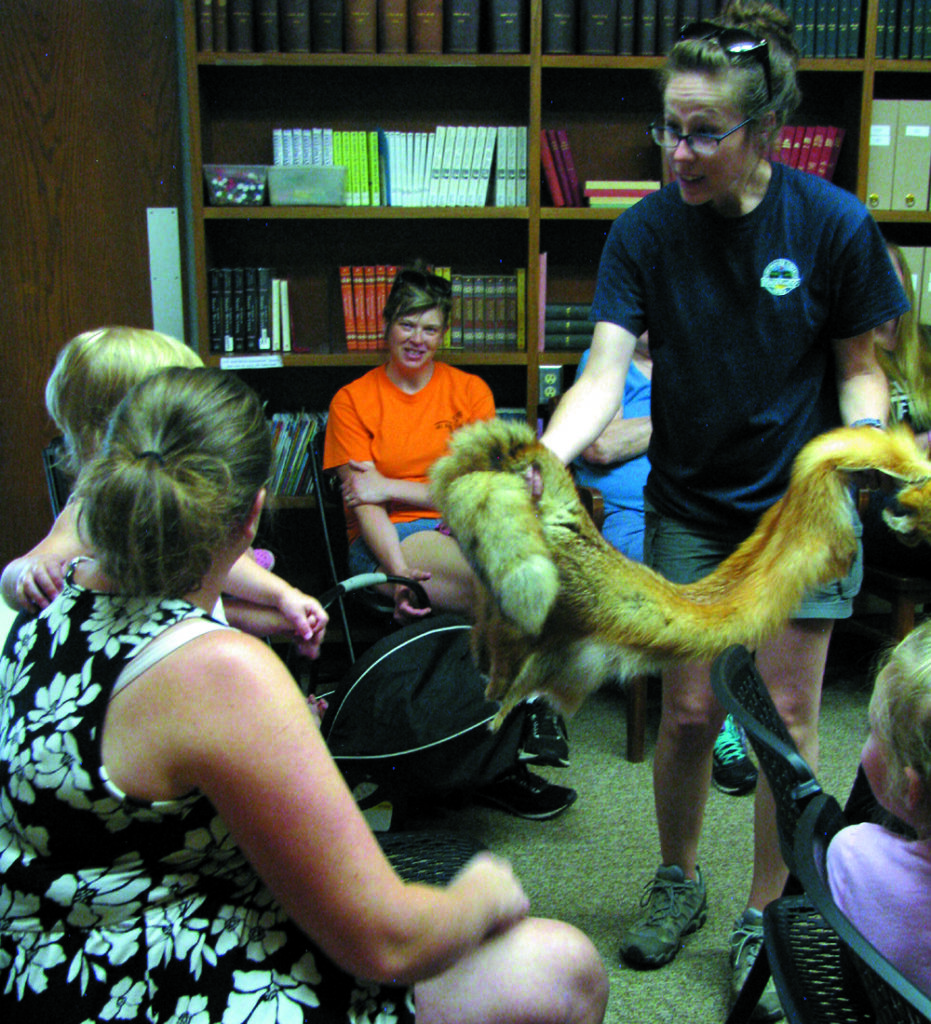
She had a big tub on the table in front of her audience. Opening up the lid, she pulled out a long, yellow in color, fur. What was it? It was a tail from a fox! Foxes are members of the dog family and can be small to medium sized. There are several foxes red foxes are common, but there are gray foxes and even a blue fox that lives in the Arctic.
Foxes that we are familiar with live in woods and farmlands. Their diet is made up of mice, rabbits, eggs, fruit, grain, garbage, and pet food. If there is a fox in your neighborhood and your pet doesn’t eat all of its food, chances are by morning it will be gone if a fox is around. They like to get into farmer’s hen houses, also.
There can be anywhere from one to 10 cubs or pups born to a fox. They are born in a den that is a hole in the ground that another animal has left. You won’t see the baby foxes for about five weeks as they stay in this hole. They leave their parents in the fall and are on their own.
She passed around the long tail for the kids to feel. That is probably the only time they will be feeling a fox tail! When foxes sleep, they curl themselves around and the tail is like a pillow to them.
She pulled out a black and white skin next. The kids knew it belonged to a skunk! Yes, the skunk does spray and when it is being chased by a predator but cannot see it, the spray surrounds the skunk like a cloud. The predator cannot see the skunk through this cloud and soon finds the “sprayer”!
She told us that skunks stamp their front paws before it sprays. This is their warning and usually it is too late for the enemy.
She said that when you see a skunk tail standing upright, go for cover! This will be the only warning you will receive before the skunk sprays you! The kids got to feel this skunk tail and were told that would probably be the only time they would get that close to a skunk!
The last tail she brought out of her tub was from a beaver. I really didn’t know a beaver tail was that big and broad! She asked how many knew about beavers. They knew that beavers can take down trees and build dams with them. Their front feet are small but their hind feet are quite large. They used them as paddles to move underwater. Fur consists of a grayish to brown layer of short, fine, and dense underfur that keeps water from reaching the skin. Their tail is scaly, flat, and paddle-shaped and measures up to abut 18 inches long and 5 inches wide. During winter, beavers store some fat at the base of their tail. They spend most of the winter in their lodge with up to 8 other beavers.
There is an oil that creates a glue-like substance that is deposited on mud or rocks to mark territorial boundaries. There are glands that secrete oil that keeps their fur sleek and water-repellent.
She passed the beaver tail around. “Do you know that this tail can ‘thump, thump, thump’ to let other beavers know what is going on? It is a form of conversation.”
Out of her tub was a book entitled, “What Would You Do With A Tail Like That?’ It had all kinds of animals and showed their tails.
We learned from Laura that “tails” are important to animals. No matter if they are long or short, the tail has a purpose for that animal.
This was the last of the summer Library story times but a very interesting one. Laura likes nature and has a way of passing this on to us. She is always a welcome presenter!