An Empty Space with Many Memories
By Elaine Rassel
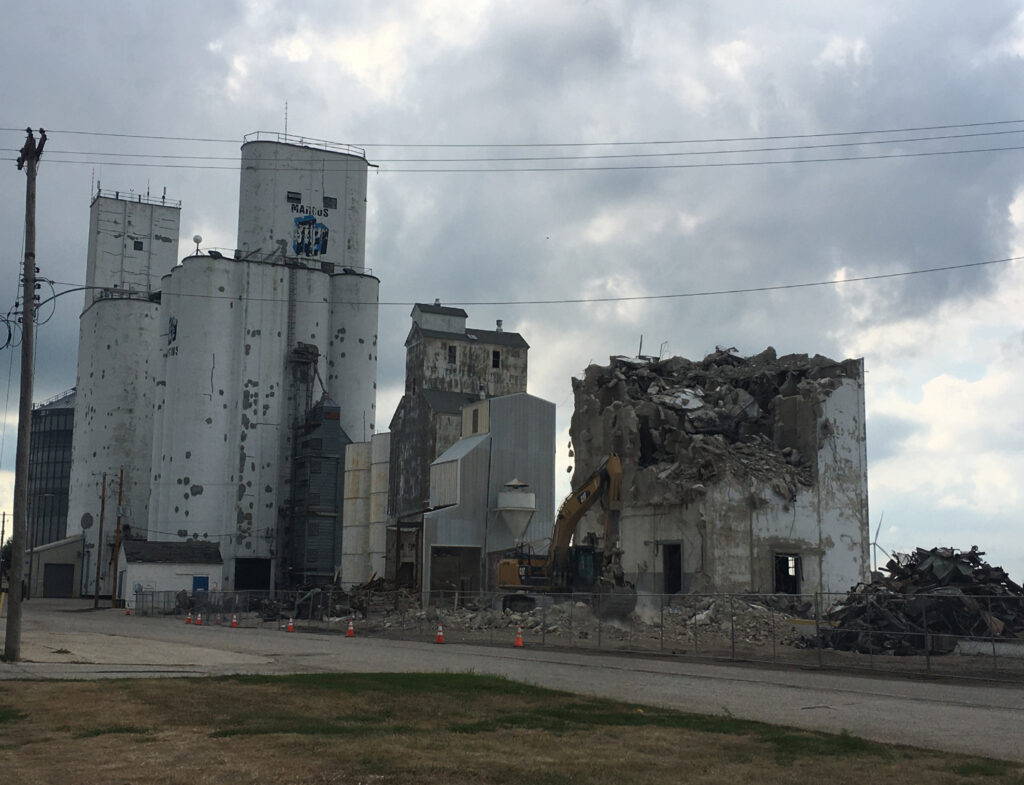
Looking at the above space, you see nothing but a wind blown area that is a catch-all for anything. However, this area has a story to tell when it served as a place as far back as 1887. Ah, the memories this space has! Let’s see if we can go back in time and bring some of these memories to life. This is where the Farmers Cooperative Elevator once stood.
This Elevator was the oldest active cooperative elevator in the nation. When Marcus was incorporated in 1887, what inspired them to be a cooperative?
The Rockdale Society of Equitable Pioneers was formed in 1844 with their major cooperative tenet being a patronage refund method. This patronage refund is where supplies are sold at market prices and savings are returned to purchasers in proportion to the volume of their patronage.
When the Marcus organization was formed in 1887, it became part of one of the fiercest commercial battles ever fought on American soil. These new railroads constructed “elevators” in the villages in an attempt to increase their tonnage. These were often sold to one person and the prices would be fixed at each of the “line elevators.” The poor farmers had no competition for their grain and the price they were paid was not satisfactory. “Line elevators” would get 50% margin on grain. They accomplished this by buying from the elevator at 40 cents a bushel and receive 80 cents when they shipped it out. The first Iowa coop elevator was started at Blairstown in 1868. There were many others operating like these, but Marcus was the earliest one that achieved permanent status.
The original organization was the name given to “Marcus Shipping Association” and was incorporated at Marcus, Iowa on December 12, 1887 with $410,000 authorized as the amount of capital stock. Wireman Miller was president and John L. Larson was secretary. The second Monday in December was the time the stockholders met annually.
As early as 1883, Marcus was recognized as the second most important shipping point between Dubuque and Sioux City. It was authorized to be a general purchasing and shipping business. It didn’t take long to realize that crops of small grain like wheat, flax, barley, and oats tended to swell the shipping interests. It was at this time that a wooden elevator was built and the business was referred to as “the farmers elevator.”
Thirteen years later (September of 1896) the farmers elevator was a thriving concern when it began taking in 60 loads of grain every work day during the harvest. Newer equipment was needed. The old steam plant that powered the elevator was removed in April 1899 and replaced by a large gas engine that was of the latest and most improved make.
The 1898-1899 board of the Marcus Shipping Association included H. J. Cushman as president, H. S. Brigs as vice president, J. Larson as secretary, Louis Gund as treasurer, Frank Tschill, C. V. Peters, J. M. Helin, Robert Gracey, and Thomas ‘Delaney.
At the turn of the century, there were many members and directors that gave voice to this stirring farmers movement. The Farmers Elevator Company was incorporated March 23, 1912. It was capitalized for $5,000 or not more than $25,000. This was a stock company with shares of $25. Half shares were sold. Each man had only one share.
The original officers of the Farmers Elevator Company were J. Q. Arnold as president; L. M. Miller as vice president; C. V. Peters as secretary; W. L. Gund as treasurer; E. A. Simons, M. McKeever, J. B. Carey, H. E. Neir and Albert Anderson as directors.
The first major construction took place when the old elevator was razed in April of 1919 and a new 35,000 bushel facility with steel siding was built on the same site. The modern equipment included a man lift, the new plant was completely electrified, 12 bins (all hopper bottom), a ten ton truck scale, and 1500 pound automatic hopper scale.
An outside office of tile and a 28×40 warehouse were other additions. L. M. Wood (manager) added livestock feeds, salt and seeds as new product lines. The business was re-opened for business August 1, 1919. The exact board in 1919 is not known, but many were holdovers to the 1912 board which included O. E. Heline, president; H. E. Neir as vice president; C. V. Peters as secretary; W. L. Gund as treasurer; A. Kenny, Ralph Porter, Henry Dorr, Sr.; A. F. Swanson and Adam Grauer. Mr. Heline went on to become president of the state grain marketing service. They took the name Shipping Association and established a business separate from the elevator. Merle Weicht was the manager and maintained an office where the Marcus Panatorium was located. They accepted small lots of livestock, made up carloads and handled the marketing for their members.
This company also came into direct competition with the elevator by buying feed in carloads; the farm wagons were loaded directly from the boxcar, thus eliminating the handling charge the elevator added to its price. The success of this venture was short lived and in 1925, the Shipping Association again connected with the elevator, with manager of elevator to act for both.
James Meylor was later hired to manage the elevator livestock interests. He did so until they discontinued the hog operation in the early 1940’s.
In 1938, a board of directors was reactivated for the Shipping Association comprising: Robert Porter, Arthur Swanson, Oscar Heline, Gust Alesch, and Fred Ritchie. These men directed that the fund of the concern be turned over to Goodburn Post, American Legion. Ralph Scott, the elevator manager, discharged all obligation to the one time Marcus Shipping association by paying $750.71 to Mr. Walsh, Legion Hall. On March 21, 1938, the Marcus Shipping Association was officially terminated.
Articles of Incorporation of the Farmers Elevator Company were amended in June 1923. They raised the amount of capital stock from $25,000 to $50,000. At that time, the total shares of stock outstanding numbered 1071. An amendment was made to allow each member to hold 20 shares of stock, rather than a limit of 10 as per the original articles.
The 1912 Charter expired in 1932, and a special stockholders meeting was called April 2, 1932. A representative of Farmer Grain Dealers Association explained the procedure for incorporating as a straight cooperative and this was accepted. Stock was revalued at $10 and replaced old stock on a basis of 2 to 1 to eliminate the existing half shares. Terms of all directors expired at rechartering, and those elected at the annual meeting in June 1932 included: Frank Rubbert, president; Walter J. Miller, secretary-treasurer; Joe Carey, vice-president; James Brady, Harry Neir, John Holmes, Otis Briggs, James Meylor, and Stanley Addy. In April 1951, the charter was again renewed; every $10 share of stock was revalued upward to $30 per share. The name of the firm was changed from Farmers Elevator Company to Farmers Cooperative Elevator.