Marcus Water Treatment Options
by Mari Radtke
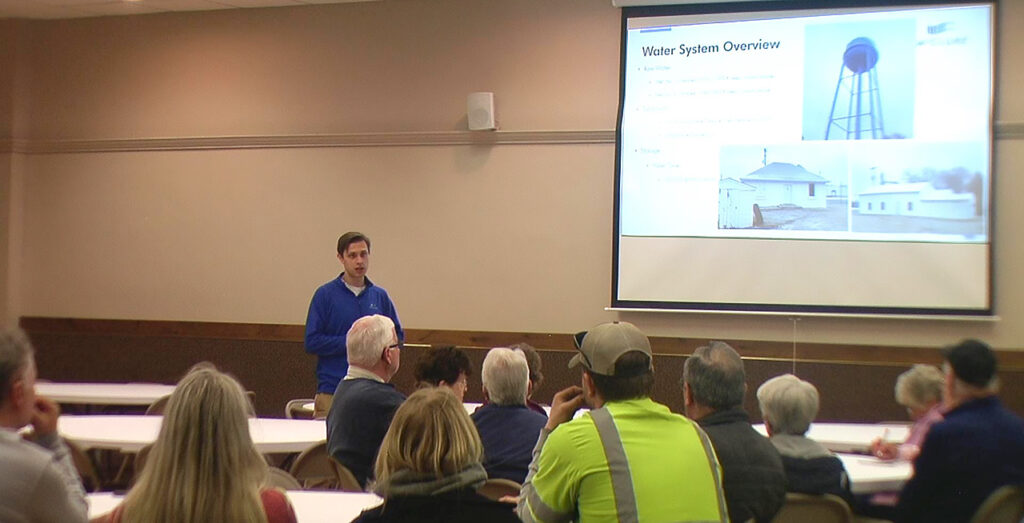
Mayor Pat Bunt opened the meeting for McClure Engineering representatives Mike Washburn and, Project Manager, to present the findings of the water system assessment and sample well results. McClure Engineering was hired by the City Council about a year ago. The project includes drilling a new well at the current site. Wells typically have a 60 year life span. Well #2 in Marcus is 100 years old. The equipment that treats the water has been in use since 1954 and all of it is original. The mission on Tuesday was to explain the options, costs and recommendations to the public.
The city has only agreed to do the study and have submitted an initial funding application to the state. The application only puts the city on a list.
? Said there are really only 2 options for this project. The pipes in the aged wells have a great deal of build up and are inefficient. Currently the city does treatment for iron and manganese, pretty typical for Iowa, according to ?. There are no known deficiencies in the water tower. It has a great capacity at 200,000 gallons for a community the size of Marcus.
A detailed discussion of the condition of the wells followed. Some contaminants in the water above DNR a secondary limit are salt and sulphates. They are not health concerns, but do have aesthetic concerns. The water is very hard. The many households with softeners can cause calcium buildup and then goes into the waste lagoons. That adds chloride to the ponds and then into the streams. That can create problems with DNR. He discussed a couple of strategies using the sulphates.
Source water, mainly in northwest Iowa are very shallow, confined aquifers. Marcus’ is silted in with not a lot of aquifer access for source water. These facts leave Marcus without an inexpensive shallow well. Drilling two new wells are one choice or a deeper well similar to the current water.
The treatment plant is aged and replacement parts are not available. The filters are taking on a lot of corrosion, but the facility is very well maintained.
The distribution system was discussed. Many of the water mains are undersized for effective fire protection. The lines are less than 6 inches, limiting water pressure. Improving the water pressure can improve the city’s insurance rating. Costs for distribution systems would be in the area of $400 per linear foot, start to finish.
One option is a pressure filtration system, as Marcus has currently. Its benefit is familiarity. A second option is direct membrane option. It pulls water from the wells and pushes the water into fine mesh filters. A lot of water with this process puts some of the filtered water back into the system for a second run of filtering. Pelletized softening is a third option not currently used in Iowa. It is messy and labor intensive. It was not presented as a favored method for Marcus. The final option is to add ion exchangers. This was described as a home softener on steroids. The pressure filtration system won’t address hardness much. Direct membrane softening will give the city the highest water quality of the options.
Cost were broken out by project – 2 wells and a water treatment plant and the second was a test well. A new building and new pressure filtration system and 2 new wells cost is estimated at $9,000,000. The direct membrane cost estimates came in at $13,500,000 for 2 wells a building and the treatment equipment. Pelletized water treatment is estimated at $14,000,000. The ion exchange option comes in at about $15,000,000. The direct membrane method is a high cost maintenance system compared with the other options. The pressure filtration plant is the least expensive option, but the direct membrane gives a better product. The direct membrane plant is the recommendation McClure Engineering is making for Marcus.
Funding options were discussed next. State programs and USDA programs are the most common sources used. Programs are a mix of loans and grants. Terms vary. Most are competitive.
Project scheduling starts with putting the city’s name on the funding list. Design, and plans and specs are next to enable permitting, expected to take approximately 6 months. Well construction should take an additional 6 months. A pilot would be 3 months at the front end and a couple more at the back end to get results. Treatment plant design is expected to take 9 months and then construction of the treatment plant would be about 24 months. The current plant will need to operate for the next 4 years after acceptance of an project.
The meeting was opened up to questions by the audience. Approximately 30 people attended the meeting.