Marcus Council Approves Submitting Water Project to DNR
by Mari Radtke
Representatives of McClure Engineering attended the January meeting of the Marcus City Council. Their presentation centered around the premise the city has two choices: Run the current system until it breaks and face an emergency or proactively plan for improvements and replacement. Council chose to be proactive.
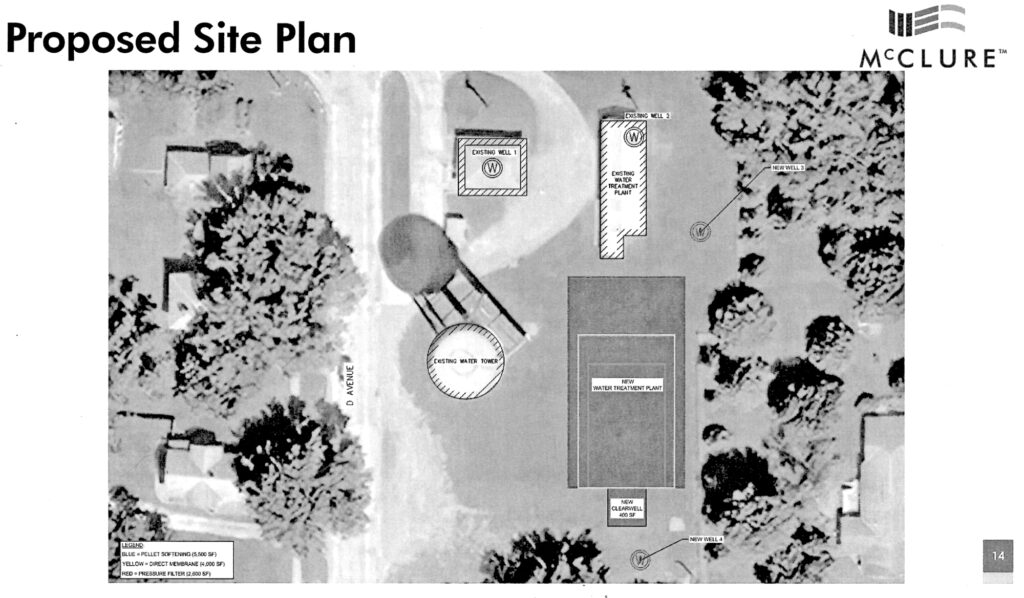
The presentation gave an overview of the current water system. Two wells from the Jordan Acquifer. Well No. 1 was dug in 1914 and is 1300 feet deep and is currently used as a backup water source. Well No. 2 was dug in 1948 and is 880 feet deep. It is the main source of water for the City of Marcus. Recent videoing shows significant buildup. It has a new motor, VFD and electrical disconnect. It has exceeded its life expectancy by at least 16 years. The recommendation for source water is to abandon and cap existing wells and construct 2 new Silurian-Denovonian wells, 800-900 feet deep near the current location. They are also encouraging the construction of a new clearwell. A clearwell allows for the water tower to be taken out of service and not interrupt water flow. There are concerns that such a tool might become required in the future.
The water treatment was constructed in 1956 and is an iron and manganese pressure filter treatment system. It uses choloramine disinfection. The well-maintained equipment is corroding from the inside. Most is original equipment, 72 years old. Replacement parts and simple repairs are becoming difficult. There is concern if the electrical equipment meets current electric code. There is no backwash flow meter and the plant cannot be operated during tower maintenance. The city has 200,000 gallons of storage capacity. Four alternatives and estimated costs including operation and maintenance, for water treatment were offered: pressure filtration, $12,454,900; direct membrane filtration, $19,220,900; pelletized softening with pressure filtration, $18,902,900; and pelletized softening with pressure filtration and ion exchange, 20,572,900. They repeatedly recommended the direct membrane system.
They explained that the new pressure filter building would have no water treatment advantage or improvement to what the city has now. Direct membrane produces the cleanest water but does have the highest operations cost. They did not entertain the idea of either pelletized method.
A test well on the Dakota Aquifer failed. It does not have sufficient capacity to meet Marcus demand. The water quality of all wells and tests is very hard.
The engineers described the water distribution system in Marcus. They used a map and a color code to show the size if pipes throughout Marcus. Pipe diameters range from unknown to 12 inches. The vast majority of pipes are 4 inch. The are some 12 inch sections and a scattering of 1 and 2 inch lines. 4-inch lines cannot sustain fire flow and water pressure conditions. DNR recommends all hydrants be served by 6-inch or larger mains to alleviate safety concerns and improve the city’s insurance rating. For budget purposes main line replacement is $400 per linear foot. The engineers recommended replacing the 4-inch lines, but added that that is not an immediate need. It was suggested that replacing the 4-inch mains happen when there is a street project.
DNR requires a study to be conducted and submitted prior to beginning the project. It’s also a first step to access funding sources including low interest loans and grants.
The early cost estimates were charted and used to demonstrate the potential impact in water bills in Marcus. Without grant funds and without assessing some of the cost to property tax, the estimated cost increase to each water bill ranges from $88.49 per month to $164.02. Councilman Steve Schmillen voiced his support of placing some of that cost burden on property taxes rather than entirely on the water bill. City Clerk Robin Harvey commented that some residents’ water bills aren’t even $100 per month.
Activity for this project begins in March with an intended Use Plan Application. Communication methods to the public will begin immediately with a public informational meeting to happen as soon as possible.