Iowa and the Underground Railroad
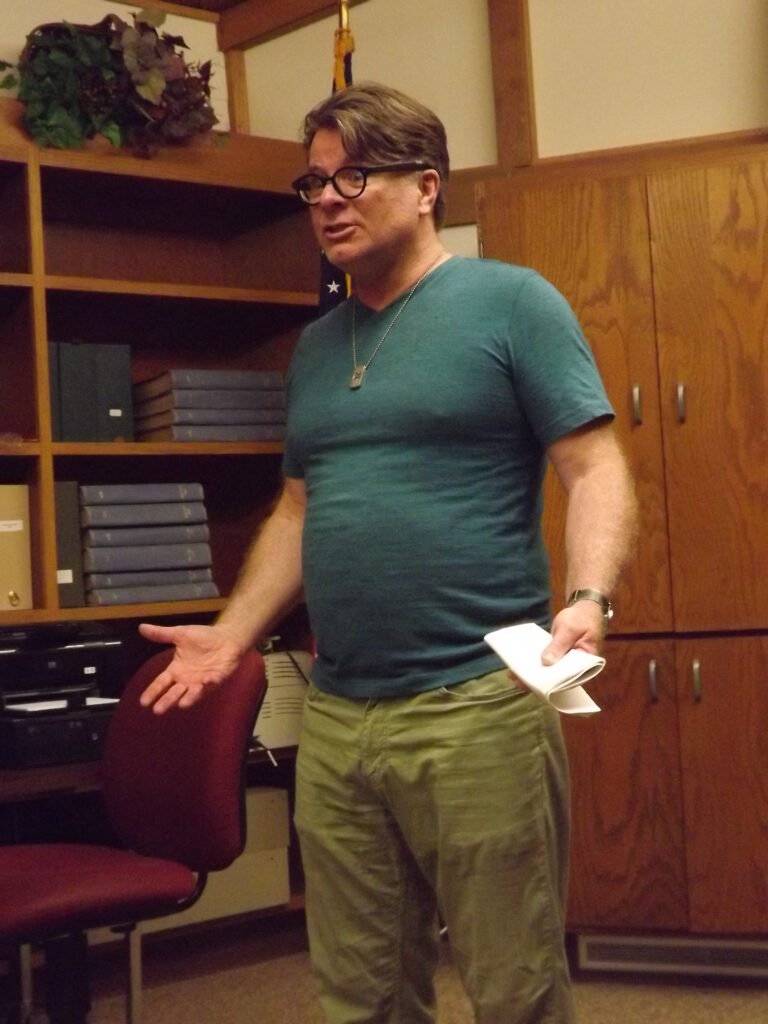
Thursday evening (May 12) Darren Crow was at the Marcus Public Library where he presented a program on the part Iowa played involving the Underground Railroad, the method that runaway slaves used to get to “free” states or to Canada before the Civil War. Just what was the “Underground Railroad”?
An organized system for helping escaped slaves from the southern states reach freedom in the North or Canada in the years before the Civil War was called “underground railroad”. It was 1831 when a runaway slave ran away from a Kentucky plantation. He was followed by his master to the banks of the Ohio River where the master lost track of him as he had swam across to Ripley, Ohio. The master returned home and told that the slave must have escaped on an “underground road”.
In 1831 the steam railroads were new and an exciting means of travel. Perhaps that is why the “underground road” now became an “underground railroad”. Those who kept safe houses for freedom seekers were called “station agents”; those who guided freedom seekers from one place to another were called “conductors” and freedom seekers themselves were called “passengers”.
Actually “underground” didn’t mean freedom seekers were hidden in basements or cellars. There were five underground railroad stops in Iowa that are now preserved the Lewelling House in Salem, Pearson House in Keosauqua, Jordan House in West Des Moines, Hitchcock House in Lewis, and John Todd House in Tabor. All of these houses have cellars, but the Hitchcock House was probably the only one that hid slaves in the cellar while other places like attics, outbuildings like the haylofts of barns, or even outside in the woods along creeks or rivers or in tall prairie grass were used to hide slaves.
Trains didn’t come to Iowa until 1855 so escaped slaves didn’t travel on trains. Wagons pulled by horses or oxen were used for transportation. Freedom seekers were transported in broad daylight by a horse-drawn buggy or carriage. Iowa was entered by freedom seekers by boat across the Mississippi River to Illinois on their way to Canada. They could have managed to escape on horses or mules; but more often or not, they used their own two feet.
There were more than 100 Iowans who helped with the “underground railroad” escapes. Many who helped were religious people who believed that slavery was wrong. Anti-slavery Quakers were those in Iowa who believed this.
The identity of African-American freedom seekers generally were never known except by their first names. Freedom seekers were not always families or women with children. Freedom seekers with children found traveling slower and were easily recaptured. There were nearly 75% of freedom seekers who were young men while the rest were young women in their teens, who did not yet have children, that were successful in escaping.
If a freedom seeker was captured by slave seeker, they were supposed to be taken before a justice of peace where the slave catcher had to prove that they had the right person. Not many cases like this happened in Iowa but their captors didn’t know them personally and couldn’t make a positive identification to the justice of peace. The Fugitive Slave Act of 1850 called for a fine of $1,000 and a term of six months in jail for anyone convicted of helping a freedom seeker escape, however there is no known case of anyone being convicted under that law in Iowa.
Only a few runaway slaves made it to the free states of the North or to Canada as most were recaptured. There could have been about 35,000 from 1830 to the end of the Civil War in 1865 who made it to freedom. There were about 4 million slaves in the South in 1860. While the underground railroad was an annoyance to slaveholders, it didn’t make much of a difference in the number of slaves held.
Many of the freedom seekers who passed through Iowa on the underground railroad came from Missouri or from Arkansas or Indian Territory called Oklahoma. Just a few came from Kentucky, Tennessee or Mississippi. There were probably not more than a few hundred who passed through Iowa on the underground railroad.
Many freedom seekers were not just waiting for help from sympathetic whites but ran away and traveled on their own. They often became station agents and conductors who helped other passengers on the underground railroad if they were successful in reaching the free states.
Missouri was a slave state and the evening’s story was about enslaved people who fled from a farm owned by Ruel J. Daggs of Luray, Clark County, Missouri. Are you ready to hear about the group of nine enslaved people on the evening of June 2, 1848 that fled? The group included John and Mary Walker and their four children, along with Sam and Dorcas Fulcher and their 18 year-old daughter, Julia who was pregnant. The two families were able to cross the border to free territory of Salem, Iowa, where an antislavery community stood vigilant to protect freedom seekers from what they considered to be unlawful.
Daggs wasn’t about to lose these nine so he hired a posse of slave catchers who caught them 48 hours later. There were 19 people in Salem that offered a compromise by suggesting that the freedom seekers be brought before an impartial justice of peace. Well, the justice of peace ruled that the Dags’ posse had presented no evidence that the nine were legally enslaved. But, in the midst of this, the slave catchers seized four of the runaways_two Walker children along with Dorcas and Julia Fulcher, and rode out of town.
None of the local or regional newspapers articles covered the escape from the Daggs farm in June of 1848, but this episode was without doubt one of the most important cases of mass escape in the history of the Underground Railroad. It involved a series of dramatic confrontations, both violent and legal, ultimately contributing to the collapse the federal fugitive slave code from 1793.
The slave state of Missouri possessed a unique slaveholding population. 88% of Missouri slaveholders had fewer than 20 men and women in bondage which was the standard threshold for plantations. In the late 1840’s, Daggs had 16 people on his 160-acre farm near Missouri’s northern border with Iowa. Being this close to Iowa, he realized he would have difficulty of keeping his slaves from escaping, so he inquired about selling some of his slaves south.
John Walker was about 22 years old when he heard about probably being sold to the South and his wife and children would be separated, so he escaped the Daggs’s farm alone in May of 1848 to find a means to free his entire family. He traveled north into the woods near the Des Moines River, where he arranged a family escape strategy with a white resident, Dick Leggens and a free African American named Sam Webster. He crossed the river into Iowa and found a group of abolitionist in the township of Salem, located about 15 miles from the Missouri border.
Salem, with a population of 500 residents, was among the first Quaker communities established in Iowa, along with small towns of Denmark and Washington Village in southeast Iowa. John Walker, the freedom seeker from Daggs’s farm, quickly established an alliance with Salem’s leading abolitionists. They helped him finalize an escape plan that included a safe house on the Missouri side of the Des Moines River. There were a network of people from Salem that would help with transportation.
Walker returned on June 2, 1848 to the Daggs farm to take his family to freedom. During the escape, three members of the Fulcher family joined the Walkers. The group was now nine with Walker, his wife, Mary; their four children, Martha, age 10, William, age 6; George, about 4, and Armistead Poston, about age 1 and included Sam Fulcher age 40 or so; his wife, Dorcas,38, and Julia, age 18 who was pregnant. If sold, John Walker and Sam Fulcher were estimated to be worth $900 to $1,200; Mary Walker, Dorcas, and Julia were each worth $600 to $700 where Martha was valued up to $300 and William, George and Armistead were worth $200. (You can see where Daggs would have made some money off these slaves.)
On the first night of their escape for the Walker and Fulcher families, they made it as far as Leggen’s remote farmstead before stopping. A heavy downpour began just at dawn which delayed the escaping parties from continuing. Then the rain stopped and Leggens and Webster helped the families to a point along the Des Moines River that could have been the shoreline of Farmington, Iowa. The current had become so swollen because of the heavy rains that the two families with the help of the co-conspirators, built a raft strong enough to cross the river into Iowa. A son of a Quaker minister, Jonathan Frazier, met them in Farmington and hid the families in a covered wagon and escorted the runaways during the remaining 20 miles north to Salem.
It was Monday, June 5, when Frazier picked up the runaways. It was during this time leading up to June 5, that Daggs had had his sons, William and George organize a posse from their neighborhood to find the nine freedom seekers across state lines. He eventually got help from four other people: their neighbor, a man from Farmington, and upon entering Iowa, two other men from Salem were asked to help.
On the morning of June 5, the four men discovered wagon tracks in the mud and followed the tracks in the direction of Salem, where they spotted the wagon about a mile away but found it empty and standing outside the home of Thomas Frazier. They spent 24 hours in Salem asking about the runaways. Two of the men returned to the original spot where the wagon tracks were first noticed; leaving the other two men behind. Too late, the nine were spotted in the underbrush near the wagon. Mary Walker turned herself over to the slave catchers as she was concerned about her four children. Then Sam and Dorcas Fulcher gave up as well as pregnant Julia Fulcher. John Walker refused to be taken. He was tied to a post One of the men was left in charge of supervising the nine while the other man traveled back into Salem to find some willing men who could assist in the safe return of the runaways to Daggs.
The delay enabled Salem abolitionists to organize help with a dozen local men who surrounded Daggs’s posse. Negotiations took place with the slave catchers and finally Salem’s Justice of Peace was asked to adjudicate the case. The slave catchers wanted a legal hearing. Word spread quickly and soon a large crowd was around Justice of Peace Gibbs’ office. John and Mary Walker sneaked away from the person guarding them with Martha. They left the other Walker children with the Fulcher family to undergo a deposition by Judge Gibbs.
Two Salem Quakers served as counsel for the alleged runaways. A trained attorney quoted from a Revised Statues of the Territory of Iowa where it was unlawful to kidnap African Americans because of personal liberty statutes in Iowa. That person guilty of this would be punished by a fine not exceeding $1,000 and by imprisonment in the penitentiary at hard labor not exceeding 10 years. Judge Gibbs ruled that these men after the runaways, did not offer enough evidence proving that they were agents working for Daggs. He concluded that the runaways had not been properly brought to him and now the Walkers and Fulchers were “free”.
Despite Gibbs’s ruling, there was a fight for the remaining alleged freedom seekers outside the place where the “trial” was held. One of the slave catchers threatened to shoot Fulcher. The crowd prevented this from happening. Fulcher and 6 year-old Walker boy were given a horse for a fast get away. Dorcas and Julia Fulcher and the two remaining Walker children were returned to Daggs’s farm by force.
On June 7, two days later, a pro-slavery mob of 100 to 300 of angry Missourians paid a return visit to the Quakers in Salem. Daggs had issued a $500 reward for the return of the five at-large runaways. Houses were illegally searched, roadblocks were placed at every exit and guards were through out the town. Those who had other runaways hidden (other than the ones from Daggs place) had to prevent anyone from entering and finding them_the house owner said he would shoot anyone who entered his house. The five runaways that were being looked for were quickly located to a nearby forest. This only led to five of Salem’s leading residents and the three who helped hide the runaways in the forest, to be held under duress at a hotel.
Two Salem residents left town unseen to get help from a sheriff in nearby Mount Pleasant and recruit abolitionists from the town of Denmark. The sheriff arrived and gave the Missouri mob 15 minutes to leave town. About 40 persons from Denmark helped scatter the Missouri mob. The four that were involved in helping the runaways escape and 14 others had to sign a pledge to appear in federal district court for their actions in allegedly helping Daggs’s slaves escape. By Friday, June 9, an interstate battle over slavery had been momentarily abated.
In September of 1848, Daggs officially filed a $10,000 lawsuit against 19 men for the loss of five runaways and to offset cost for the services of his four slave catchers. The case was finally heard in June of 1850 with a newly confirmed U.S. District Judge John Dyer who acknowledge during the trial that the events in Salem were part of growing national divisions over slavery where in pro-slavery and antislavery persons maintained a warlike attitude, especially over what to do with new territory recently obtained from Mexico. He advised the panel to adjudicate the 1793 Fugitive Slave Law, which imposed a hefty financial penalty on any person “knowingly and willingly” obstructing hindering, harboring, or concealing freedom seekers.
Now Daggs’ attorney asked permission to file a bill of exceptions with the intention of appealing the decision to the U.S. Supreme Court. Their strategy was merely of delay. None of the defendants, except for one, was worth the amount levied by the court. Most of them, apparently sold their property to their kin ahead of the trial with the aim of avoiding paying any penalty to Daggs. Daggs was never actually paid the fine that the verdict promised. He never collected a dime and gave up his pursuit in disgust.
Daggs sold all but six of his enslaved persons not long after the episode. He still possessed three males age 55, 30, and 1; and three females, ages 40, 20, and 20. Daggs, himself had 10 children. Ruel Daggs died in December of 1862 and is buried in Daggs homestead cemetery, located 3 and one half miles south east of Luray, Missouri.