Blank Park Zoomobile Visits
Marcus Public Library
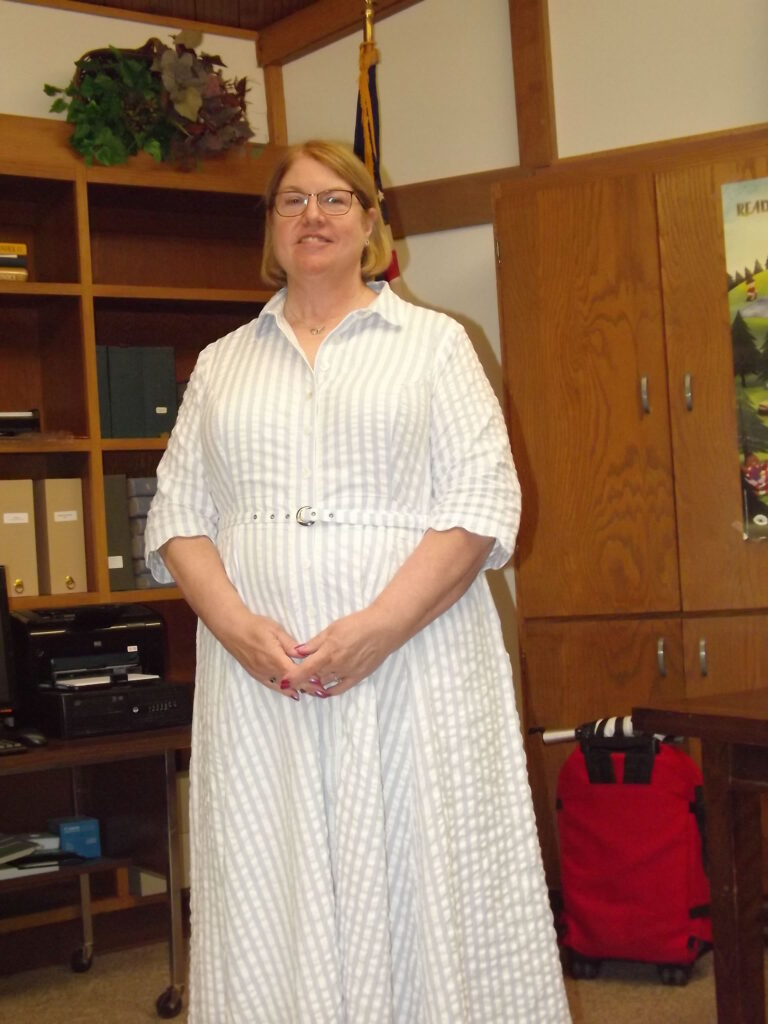
This year’s Summer Programs at the Marcus Public Library are in coordination with “Read Beyond Path” with the program on Wed. (June 22) given by Blank Park Zoomobile from Des Moines. In the past, the Zoo has brought animals, but with the hot weather we have had, this year they only brought two living things to show us. Oh, but that wasn’t all they showed as “Carrie” had pictures of animals and trees, etc. that are not found in Iowa.
She opened her presentation with a picture of a shagbark hickory tree to a “packed house” with kids as well as adults. (I wish I could show you the pictures that I took of what she was showing, but I know this would not be possible.) I had never seen a tree that looked like this one_it’s bark looked like lightening could have struck it and left the bark “shredded”. It is a common hickory tree in the Eastern United States and southeast Canada. It is a large tree that grows over 100 feet tall and can live more than 350 years. This tree is easy to recognize because it has “shaggy bark”. Only mature trees have this shaggy bark and younger trees have smooth bark. The tree has a hickory nut that can be eaten and has a very sweet taste.
She showed kids walnuts and compared this to the fruit of the shaggy hickory tree. She asked the kids what happens to walnuts when they are on the ground. They knew that birds and some animals pick them up. The hickory nuts are a food source for red and gray squirrels, raccoons, chipmunks, and mice. Bigger animals like black bears, gray and red foxes, rabbits and some birds also eat them.
She found a helper that was handed a rectangle piece of fur. Could any of us identify the fur? She showed a picture of a Virginia opossum that is the only opossum found north of Mexico. We know opossum better known as “possum”. It is a solitary and nocturnal (night) animal about the size of a house cat.
We probably have had one at our place and didn’t realize it. They like food that is in trash cans, pet food (that a pet hasn’t eaten all of it), compost piles, gardens, rodents, etc. They are easy “roadkill” because they are slow and at night hard to see.
The Virginia possum comes from a word meaning, “white animal”. Larger specimens are found north and smaller specimens in the tropics. They measure 13-17 inches long from their snout to the base of the tail with the tail adding 8 more inches. A male weighs from 1.7 to 14 lb. and females from 11 ounces o 8.2 lb. They are one of the world’s most variably sized mammals, since a large male from northern North America weighs about 20 times as much as a small female from the tropics.
Their coats are a dull grayish brown, while their faces are white. They have long, hairless tails they can be used to grab branches and carry small objects. They have hairless ears and a long, flat nose. They have 50 teeth, more than any other North American land mammal, and clawless thumbs on their rear limbs. Its brain is one-fifth the size of a raccoon’s.
If a possum is threatened, it either flees or takes a stand. To show the opponent that it is threatening, it will first show its 50 teeth, snap its jaw, hiss, drool, and stand its fur on end to look bigger. If this doesn’t work, it will “play possum” meaning to pretend it is dead or injured. It can play dead for several hours or until the opponent goes away.
They can eat a wide range of plant-based food, small invertebrates, eggs, fish, reptiles, birds, small mammals, and other small animals. Insects like grasshoppers, crickets and beetles make up the bulk of animal foods. Possums eat up to 95% of the ticks they encounter and may eat up to 5,000 ticks a season, helping to prevent tick-born illnesses like Lyme disease and Rocky Mountain spotted fever.
Small animals eaten include young rabbits, mice, rats, birds, snakes, lizards, frogs, fish, and crayfish. They are immune to snake venom. Plant foods are eaten in late summer and early winter. These are raspberries, blackberries, apples, acorns, beechnuts, and vegetables. In urban areas, possums look for bird feeders, vegetable gardens, garbage cans and foods left over from dogs or cats.
The Virginia possum is most active during the spring and summer. It does not hibernate but reduces its activity during the winter. They may not leave their den for several days if the temperature drips below -7 to -4 degrees.
A female possum may have one to three litters per year. Newborn possums are the size of a honeybee. Once born, the newborn climb up into the mother’s pouch and latch onto one of her 13 “milk faucets”. The young remain latched for two months and in the pouch for 2 and one-half months. The young climb onto the mother’s back where she carries them for the remainder of their time together (about four or five months). The Virginia possum has a maximal lifespan in the wild of only about two years or in captivity about four years.
We were shown a picture of a millipede. (Of all the pictures she showed, this was one I didn’t like probably because I don’t like anything with that many legs!) The millipede has approximately 10,000 species that live in and eat decaying plant matter; some injure living plants, and a few are predators and scavengers. The characteristic feature of the group is the presence of “diplosomites”, double trunk segments formed from the fusion of two segments. They have as many as 200 pairs of legs_two pairs on each diplosomite except for the first (head) segment, which is legless, and the next three segments, which each contain one pair of legs. And, each diplosomite (except for the first four) contains two pairs of internal organs (two pairs of ganglia and two pairs of heart arteries). The head contains antennae, simple eyes, and only a single maxilla. They can be 2 inches to 11 inches in length. The number of segments can range from 11 to more than 100 in some species. All but one order of millipedes are armoured with calcareous dorsal plates. In defense, they do not bite but most tuck its head first into a tight coil with the exoskeleton exposed, and many secrete a pungent, toxic liquid or gas from lateral glands. Some millipedes lack eyes and are brightly colored. Some are common to many gardens.
Let’s move on to something not quite as scary! She showed a picture of a Northern Walkingstick and actually had one with her. The Walkingstick insect is a single word while a walking stick (two words) helps you balance when you hike.
Walkingsticks were formerly classified in the grasshopper order but are now in their own Order. Because of their unique shapes and habits, they’ve collected common names like: Devil’s darning needle, Devil’s/Witch’s riding horse, and prairie alligator. There are about 3,000 species worldwide, and they’re most diverse in the tropics.
They are very slow moving, long, thin wingless insects that look like a twig. This allows them to camouflage on trees and bushes during the day. These brown or green insects have very long antennae, about 2/3 the length of their body. The male is smaller (3 inches long) than the female (3.25 inches long). They have the ability to regenerate lost legs.
They are shy and nocturnal, most active between 9 p.m. and 3 a.m. They have screening pigments in their eyes that act to block excessive light of daytime. They graze on the leaves of many forest trees, starting on low shrubbery and move on to mature trees as adults. They are hard to see and there are two reason for camouflage_to hide and to hunt. In addition to their physical appearance, walkingsticks use “behavioral camouflage”; during the day they extend their front and rear legs to the fore and aft of their body and remain motionless or sway slightly in the breeze for hours.
Even though they are camouflaged, there are some predators that aren’t fooled; walkingsticks are spotted and eaten by a variety of songbirds and rodents especially in boom years. They are attacked by several parasitic wasps and flies.
Northern walkingsticks reproduce when they mature in late summer/early fall. Their eggs look like “seeds”. They hatch in spring or even later. Nymphs start out green, and get twiggier-looking in color and texture as they molt, hanging on to the underside of a leaf. Adult males tend to be brown, and females green and brown. Sometimes their offspring are all females. Their lifespan is one year in captivity. (The Walkingstick she was holding, seemed very calm.)
There was a log on the table. She had one of her helpers reach in and pull out a “snake skin”. The log was one of the hiding places for a snake.
Another helper reached in and pulled out a skunk hide! All the kids seemed to know about a skunk and not to get near it!
She showed a picture of prairie grass (grass that had never been cut or dug up) that we don’t see anymore. There was also an eagle feather shown and kids were asked what they knew about eagles. Had they seen an eagle in Marcus? Maybe out in the country but probably not in town.
The other living thing she had with her was a “Eastern Box Turtle”. She put a gray towel on the table and put the turtle down. This turtle didn’t put its head in and hide, it was on the move so that she was constantly keeping it from going over the edge of the table.
The Eastern Box Turtle is largely found on land rather than in a pond. They are slow moving , live long, are slow to mature, and have relatively few offspring per year. The box turtle species are susceptible to human-induced, mortality hit by agricultural machinery or vehicles.
They have a high domelike back and a hinged plastron that allows total shell closure. Their back can be of variable coloration but is normally brownish or black with yellow or orange radiating pattern of lines, spots, or blotches. Males possess red eyes where females usually have brown eyes. They feature a sharp, horned beak and stout limbs, and their feet are webbed only at the base. They have five toes on each front leg and four toes on each hind leg. They range in size from 4.5 inches to 8 inches long.
When in danger, the turtle is able to pull hinged sections closely against the back, and seals the soft body in bone, hence forming a “box”. The shell is made of bone covered by living tissue and covered with a layer of keratin (this is a tough fibrous protein, the basic substance of hair and nails). This shell is connected to the body through its fused rib cage which makes the shell permanently attached and not removable.
When injured or damaged, the shell has the capacity to regenerate and reform. Granular tissue slowly forms and keratin slowly grows underneath the damaged area to replace damaged and missing scutes. Over time, the damaged area falls off, revealing new keratin formed beneath it.
The Eastern box turtle is found mainly in the eastern United States. They prefer mixed forested regions, with a moderately moist forest floor that has good drainage. But, they can be also found in open grasslands, pastures, or under fallen logs or in moist ground, usually moist leaves or wet dirt. They have been known to take baths in ponds, etc. during hot periods and may submerge in mud for days a a time. (If in water too long, they may drown.) Many Eastern box turtles try to avoid stressful environmental conditions. When winter is in season, these turtles will burrow into the soil and stay dormant until the temperature rises.
They have been known to stay in the same home range for 32 years. They rarely travel more than 1.5 miles from their home territory. They can lessen their appetite and retreat into their shells and not be hungry. In the wild, box turtle eat earthworms, snails, beetles, caterpillars, grasses, weeds, fallen fruit, mushrooms, and even flowers. They have fed on live birds trapped in netting.
People buy captive-bred box turtles for pets. Captive turtles have a life span as short as three days if they are not fed, watered, and held in a proper container. They require high humidity, warm temperatures, and suitable substrate for burrowing. They have to have a large dish for bathing and drinking in. They have to live on crickets, worms, earthworms, beetles, cockroaches, small mice, fish (not goldfish), wild strawberries, clover, lettuce, and mushrooms. There is commercial food available, but can be costly. Captivity box turtle can live over 100 years but not as long in the wild.
Even though we might have missed some of the live animals they had brought in the past, Carrie’s presentation was informative and interesting.
Next Wednesday, June 29 come to the Marcus Community Center for a program, that is also a Zoo program but different than the Blank Park Zoo program. This program is ISU Insect Zoo Beyond Bugs. The program starts at 1:30.