Stockholders Vote “Yes”
By Mari Radtke
A Career Academy by Northwest Iowa Community College (NCC) has been anticipated in Marcus for several months. Highs and lows over final planning have been felt throughout the Marcus Community. The college has been awarded $1 million grant to develop the regional learning center. Location became the feature holdup. City owned lots were considered and not acted upon. Most recently, the NCC Board of Trustees approved an offer for what is currently Hometown Guesthouse.
The Hotel was established in 2008. The attraction was a community wide effort to build the hospitality feature. Financing came from local individuals as well. There are 1886 outstanding shares, each owning a vote.
By the closed session item to discuss a potential real estate purchase on the NCC Trustees agenda for August 25, 2025, it appears the Trustees approved making an offer on the Hometown Guesthouse property in Marcus.
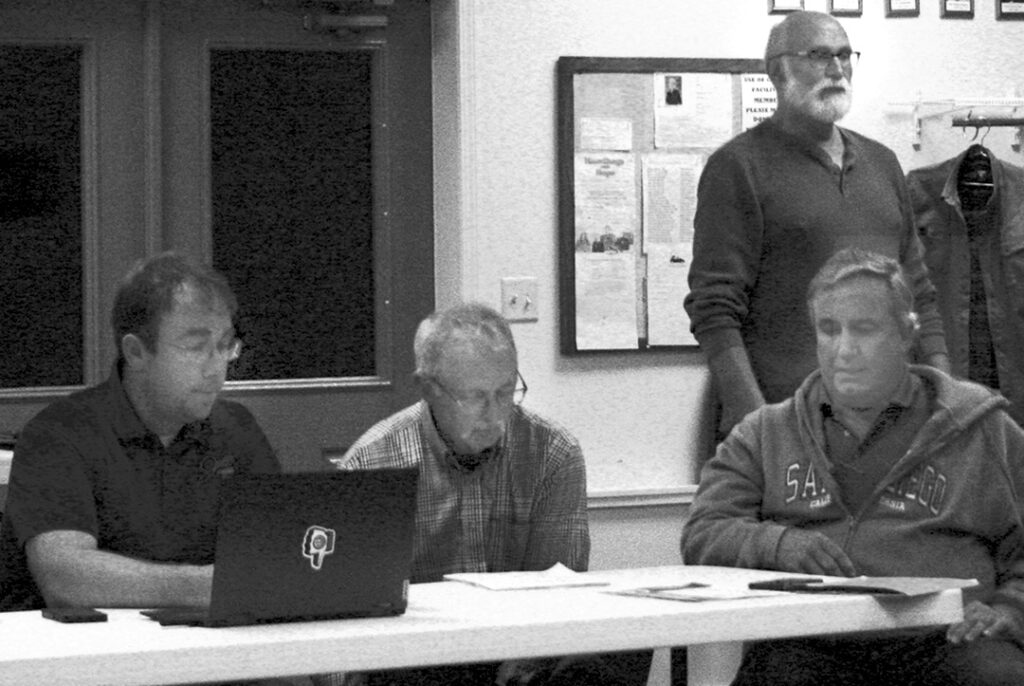
A shareholders meeting was called for November Wednesday November 5, 2025 to discuss the sale of Hometown Guesthouse to NCC to be redeveloped into a Regional Learning Center and Career Academy. Dr. John Hartog, President of NCC made a presentation to the approximately 25 shareholders who attended.
Dr. Hartog provided an overview of a Regional Center delivering Career Academies serving Marcus and the surrounding communities. He started by telling the audience that the transaction, pending shareholder approval, “is not an investment in the building. It is an investment in the region.” He took the position that the Regional Center provides a better education even without transportation. He cited expanded access (to offered programs, aka pathways) and referred to the performance of the Sioux Center Academy. In Sioux Center there are a small number of high school students during the day (12 in 2025, up from 3 in 2024) and 76 adults in the evening. He noted that the Sioux Center Regional Center is now recommended for full accreditation. A Regional Center must provide access to at least four career academy programs and serve either a combined minimum of 120 students from at least two school districts or a minimum of four school districts. Hartog cautions that experience says enrollment will start slow and build overtime, noting the growth experience at both Sheldon and Sioux Center.
The Grant scoring rubric to evaluate the success of a Regional Center look at historical enrollment provided for each partnering high school over a five-year period. The enrollment trend helps determine sustainability of the Center. Formalized contracts with an individual school board approval may be an alternative measure for sustainability. The Rubric awards higher points to an application that has not received a grant or been awarded recently. Points awarded decline as the time since last award received declines.
Career Academy eligibility requires an application coming from one school district and one community college. A proposal that includes multiple school districts along with a community college becomes a Regional Center and will be given higher priority. The Marcus Regional Center has support from Kingsley-Pierson, Remsen St. Mary’s, MMCRU, River Valley and South O’Brien. Signed Memorandums of Understanding (MOU) are signed.
Pathways for reaching a degree in less time, up to a year fully using the Regional Center, available at MMCRU will be Education, Welding, Healthcare and Design Technology. Teaching staff at the high school will stay in their current role.
Normally, community colleges are protective of their merged area. In this case, according to Hartog on Wednesday, NCC had the blessing of Dr. Terry Murrell, President Western Iowa Tech Community College for the Marcus Regional Center. Hartog expressed the opportunity to provide non-credit opportunities in the hour for such things and EMT training.
The Career Academies for high school students are generally open to juniors and seniors, although when asked specifically, Hartog noted that it is not a current offering, but could be a case-by-case situation. A junior starting with a pathway and taking all available dual credit courses for that pathway and then again in their senior year could conceivably graduate with 12 college credit hours toward their program degree.
Enrollment in a Career Academy Pathway provides dual credit for the student. The dual credit enrollment is not a new concept. It has been offered to high school students through their community college for many years. Hartog points out that the Career Academy adds a “hands-on” element for learners. He also noted that it can give a prospect experience that can more easily provide the student with what their interest really is about a specific career pathway.
The handouts provided about the Career Academy and also promoted by Hartog during his presentation described one of the benefits is “No tuition costs” for high school student. This is the same benefit for every high school student taking dual enrollment classes, which are paid by the school district to the community college. When asked, Hartog explained the school district payment is true for both forms of obtaining college credit, making the tuition a taxpayer expense. Hartog went on to explain that the state reimburses the school district for dual enrollment tuition costs to the districts’ supplemental aid fund.
A special meeting of the NCC Board of Trustees held Friday November 7 addressed a potential Career Academy at Rock Rapids and MOUs with Rock Rapids area school district.
By the end of the shareholders’ meeting on Wednesday, just over 52% of the shares had voted. That is enough for a quorum of votes. The votes were overwhelmingly in favor of the sale. The margin was too large for the outstanding votes to overcome a sale..